
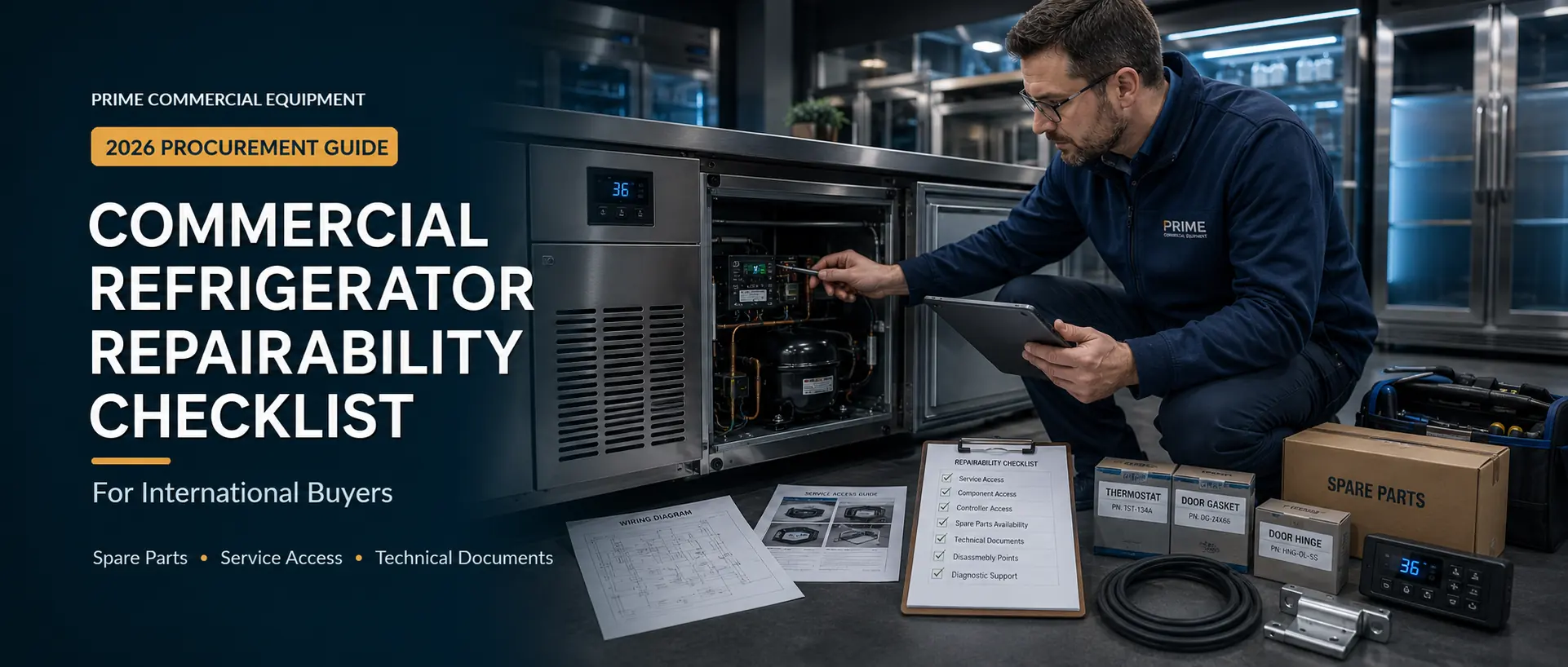
Commercial Refrigerator Repairability Checklist for International Buyers
Commercial refrigeration equipment should not be evaluated only by temperature range, cabinet dimensions and purchase price. International buyers should also confirm whether compressors, controllers, fans, door parts and service documents will remain accessible after the equipment arrives.
Reduce downtime
Identify service parts before failure
Exact controller, sensor and fan information allows local technicians to prepare suitable replacements more quickly.
Protect project value
Check access before installation
A cabinet can become difficult to maintain when the condenser, drainage system or refrigeration unit cannot be reached.
Improve handover
Request documents with the shipment
Manuals, wiring diagrams and part numbers are much easier to obtain before the order is completed.
Section 01
Why Repairability Matters in Export Projects
Domestic buyers may have direct access to the manufacturer’s technicians, component warehouse and local service network. An international buyer may instead depend on a local refrigeration technician, remote diagnosis and replacement parts sent by courier.
This means a minor controller, sensor or door-seal problem can create unnecessary downtime when the original component cannot be identified or ordered separately.
- Can the failed component be reached without damaging the cabinet?
- Is the exact replacement component identified?
- Can a locally available equivalent be used?
- Are wiring and controller parameters documented?
- Can replacement parts be packed and shipped safely?
- Will the supplier support model and serial-number matching?
Section 02
EU Policy Context and an Important Boundary
The European Union’s wider ecodesign framework increasingly considers product lifetime, spare-parts availability and access to repair and maintenance information. EPREL can also provide complementary repair or spare-parts information for some regulated product groups.
Professional refrigerated storage cabinets are currently covered by EU ecodesign and energy-labelling regulations, and the European Commission states that the review of these regulations is ongoing.
This does not mean that every commercial refrigerator currently has a mandatory EU repairability score. The applicable requirements must be checked for the exact product group and current product-specific legislation.
The checklist in this article is therefore a procurement and lifecycle-management tool. It does not claim that every field is a compulsory regulatory requirement for every commercial refrigeration product.
Section 03
Compressor and Refrigeration Components
The compressor is one of the most important parts to identify before a commercial refrigerator is purchased. A catalogue statement such as “famous-brand compressor” is not sufficient for technical handover.
Compressor
Confirm manufacturer, exact model, refrigerant, voltage, frequency, capacity and equivalent replacement options.
Condenser
Confirm type, fan arrangement, cleaning access, ventilation direction and replacement method.
Evaporator
Confirm fan access, cover removal, drainage, heater arrangement and probe position.
Expansion Device
Identify the capillary tube, expansion valve or other flow-control component used in the system.
Filter Drier
Record the model, connection size and refrigerant compatibility for future refrigeration service.
Service Ports
Confirm location, access and compatibility with the intended maintenance procedure.
Information buyers should request
- Compressor manufacturer and complete model number
- Refrigerant type and refrigerant charge
- Cooling-capacity or application data
- Starting and overload-protection arrangement
- Condenser and evaporator component information
- Refrigeration circuit diagram
- Equivalent replacement policy
Section 04
Controller and Electrical Parts
“Digital temperature control” is not a sufficient controller specification. Buyers should obtain the exact controller model, terminal arrangement, parameter list and alarm-code information.
Controller information
- Controller brand and model
- Input voltage
- Relay capacity
- Temperature probe type
- Defrost probe type
- Parameter-setting manual
- Alarm and error codes
Electrical service parts
- Contactor and relay
- Circuit breaker and fuse
- Transformer
- Door switch
- Power switch
- LED light and driver
- Defrost and drain heaters
For project orders, a pre-programmed spare controller can be more useful than an unidentified generic spare. Buyers should also confirm whether replacement requires access to a password, firmware or factory-specific parameter file.
Section 05
Door, Gasket, Hinge and Glass Replacement
Door components experience frequent use and are vulnerable during international transport. Replacement options should be reviewed before the cabinet enters service.
| Component | What to verify | Common procurement risk |
|---|---|---|
| Door gasket | Profile, dimensions, fixing method and separate availability | Gasket bonded permanently or replacement profile not documented |
| Hinge | Model, mounting position, adjustment and replacement access | Complete door required for a minor hinge failure |
| Handle | Fastening method, hole spacing and separate part number | Handle bonded or integrated into the full door frame |
| Glass door | Heated or unheated glass, frame structure and packing method | Glass panel cannot be replaced separately |
| Sliding lid | Glass dimensions, roller or track arrangement and removal method | Custom glass dimensions unavailable after shipment |
Section 06
Condenser, Evaporator and Drainage Access
Maintenance access must be reviewed together with the planned installation position. A cabinet that can be serviced in an open factory area may be difficult to maintain after it is built under a bar counter or against a wall.
Condenser access
- Front, rear or bottom service access
- Air inlet and outlet direction
- Filter removal
- Cleaning without moving the cabinet
- Minimum ventilation clearance
- Panel fastener type
Evaporator and drainage
- Evaporator cover removal
- Fan motor replacement
- Drain-pan access
- Drain outlet location
- Probe and heater access
- Ice-removal procedure
Worktop refrigerators, undercounter refrigerators and back bar coolers need particular attention because their rear or side access may be restricted by the installation layout.
Section 07
Components Embedded in the Foamed Cabinet
Commercial refrigerator bodies commonly contain foamed insulation. Refrigeration pipes, heater wires, drainage routes or structural parts may be embedded inside the insulated cabinet and may not be replaceable without damaging the body.
- Ask which refrigeration pipes are embedded in the insulation.
- Identify anti-condensation heater wiring around doors and frames.
- Confirm drainage routes inside the cabinet body.
- Request marked no-drill areas where relevant.
- Confirm whether side and rear panels are removable.
- Check whether the refrigeration unit can be removed as a complete module.
Section 08
Documentation Handover Checklist
Product photographs and sales brochures are not substitutes for technical service documents. The handover package should be agreed before shipment.
Technical drawings
- Exploded parts diagram
- Numbered component list
- Electrical wiring diagram
- Refrigeration circuit diagram
- Installation clearance drawing
Operating documents
- Controller manual
- Parameter-setting sheet
- Error-code list
- Cleaning instructions
- Preventive-maintenance schedule
Component records
- Compressor model
- Fan motor models
- Sensor specifications
- Door gasket profile
- Electrical part numbers
Project identification
- Cabinet model
- Serial-number format
- Production date
- Voltage and refrigerant version
- Supplier contact process
Section 09
Recommended Spare-Parts Packages
The correct spare-parts package depends on order quantity, destination, local availability, transport lead time and the operational importance of the equipment.
Routine replacement parts
- Temperature sensors
- Relays and fuses
- Power switches
- Door gaskets
- Hinges and handles
- LED components
Critical service components
- Pre-programmed controller
- Condenser fan motor
- Evaporator fan motor
- Fan blades
- Defrost heater
- Drain heater
- Door switch
Long-lead or model-specific parts
- Compressor
- Complete controller assembly
- Complete door assembly
- Custom glass or lid
- Proprietary circuit board
- Custom stainless-steel parts
A fixed spare-parts package should not be applied to every product. PRIME recommends preparing the list only after the selected model, component brands and destination service conditions are confirmed.
Section 10
Parts Availability and Serial-Number Tracking
Do not state that spare parts are guaranteed for a fixed number of years unless the supplier has formally confirmed that period for the exact model and component supply chain.
- Expected production period for the cabinet model
- Confirmed availability period for model-specific components
- Parts purchased from third-party component manufacturers
- Equivalent replacement policy
- Minimum spare-parts order quantity
- Typical production and courier lead time
- Packaging method for glass, controllers and fragile parts
- Serial number and photo information required for future orders
Keep the equipment serial number, nameplate photo, controller model, compressor model and wiring diagram together in the project file.
Section 11
Commercial Refrigerator Supplier Evaluation
Supplier support should be evaluated before the purchase order, not only after a fault occurs.
Parts Identity
Can the supplier provide exact brands, models and component references?
Stable Configuration
Will changes to compressors, controllers or fans require buyer approval?
Documentation
Are wiring diagrams, manuals and parts lists available before shipment?
After-Sales Process
Can the supplier match replacement parts using model and serial information?
Section 12
How PRIME Coordinates Service and Spare-Parts Information
PRIME Commercial Equipment can coordinate service-access information, component identification, manuals and recommended spare-parts packages during the sourcing and quotation process.
Before quotation
- Confirm product type and destination
- Review local service conditions
- Identify critical components
- Clarify required documentation
Before shipment
- Check model and component information
- Collect available manuals and diagrams
- Confirm spare-parts package
- Review packing and identification
Repairability depends on the selected model, product structure, manufacturer and component supply chain. PRIME coordinates available information but cannot apply one universal repairability promise to every commercial refrigerator.
Related PRIME Resources
Commercial Refrigeration and Procurement Pages
Section 13
Frequently Asked Questions
Is repairability the same as warranty?
No. Warranty defines agreed responsibility during a stated period. Repairability concerns service access, component identification, documents, spare parts and the practical ability to restore the equipment.
Does every EU commercial refrigerator have a repairability score?
No. Buyers should not claim that all commercial refrigerators currently require a universal EU repairability score. Requirements depend on the exact product group and applicable legislation.
Should every order include a spare compressor?
Not necessarily. The decision depends on order quantity, compressor availability in the destination country, delivery time and the operational importance of the equipment.
Which spare parts should normally be reviewed first?
Controllers, sensors, fan motors, gaskets, hinges, relays, switches and model-specific electrical components are usually the first items to evaluate.
Can a local controller replace the original controller?
Sometimes, but compatibility must be checked for voltage, sensors, relay capacity, defrost logic, alarms and parameter settings.
Can PRIME guarantee local repair service?
Local service depends on the destination and project arrangement. PRIME can coordinate component information, technical documents and recommended spare parts with the selected supplier.
Official References
Policy and Product Information Sources
Regulatory requirements and product scopes may change. Buyers should verify the exact product category and current legislation before placing equipment on a regulated market.
Service & Spare-Parts Coordination
Request service information before the refrigerator leaves the factory.
PRIME can coordinate available component models, wiring diagrams, controller manuals, recommended spare parts and service-access information for the selected commercial refrigeration equipment.