

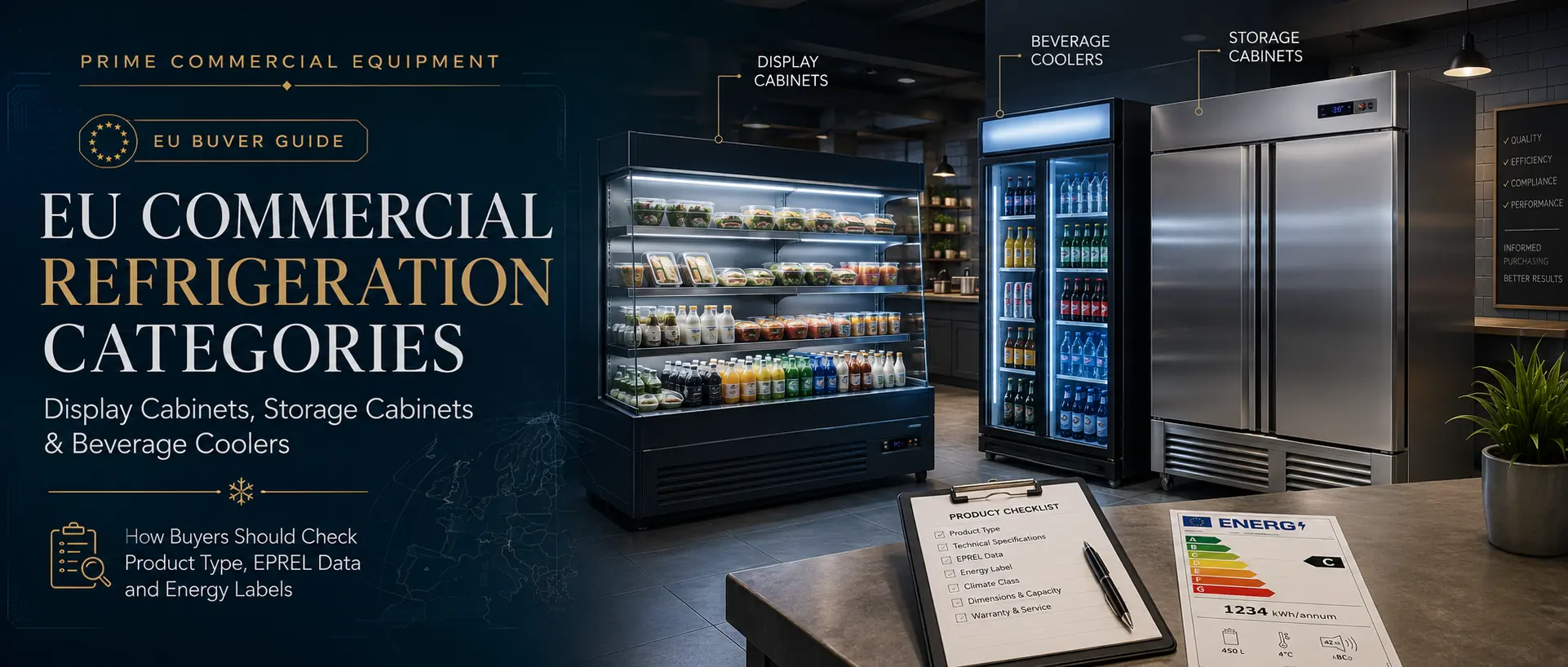
EU Commercial Refrigeration Categories Explained: Display Cabinets, Storage Cabinets and Beverage Coolers
EU commercial refrigeration categories cannot be determined from a general product name such as “commercial fridge.” Buyers should distinguish direct-sales display equipment from professional refrigerated storage cabinets and then verify the exact cabinet type, use, temperature data and EPREL information.
Direct sales
Equipment designed for display and sale
This group includes supermarket cabinets, beverage coolers, ice-cream freezers, gelato cabinets and refrigerated vending machines.
Professional storage
Equipment used by professional operators
These cabinets primarily preserve refrigerated or frozen goods in kitchens and other non-household professional environments.
Buyer action
Match documents to the exact model
A similar product image or related model number should not replace the correct energy label, information sheet and registration record.
Section 01
Why EU Commercial Refrigeration Categories Matter
“Commercial refrigerator” is a useful general sales expression, but it is not always precise enough for technical procurement, energy labelling or regulatory assessment.
A glass-door beverage cooler, an open supermarket chiller, a stainless-steel kitchen refrigerator and a horizontal ice-cream display freezer can all be described as commercial refrigerators. Their product functions, required data and classification may nevertheless differ.
- Classification can affect the applicable energy-labelling framework.
- Different categories use different capacity and display parameters.
- Some products are assessed by volume, while others use total display area.
- Temperature classes and ambient conditions may differ.
- EPREL information must match the exact model identifier.
- Importer and supplier responsibilities depend on the actual product scope.
Section 02
Two Important EU Refrigeration Product Groups
The European Commission lists Commercial Refrigerators and Professional Refrigerated Storage Cabinets as separate energy-efficient product groups.
Refrigerating Appliances With a Direct Sales Function
These appliances are primarily designed to display refrigerated or frozen products for sale and may allow direct consumer access or automated dispensing.
- Supermarket display cabinets
- Beverage coolers
- Ice-cream freezers
- Gelato-scooping cabinets
- Refrigerated vending machines
Professional Refrigerated Storage Cabinets
These cabinets are primarily intended to preserve goods in non-household professional environments and are normally accessed by professional users.
- Commercial kitchen upright refrigerators
- Solid-door professional freezers
- Professional undercounter cabinets
- Refrigerated worktables
- Back-of-house storage cabinets
Installation in a commercial building does not automatically make a cabinet a professional refrigerated storage cabinet. Its primary function and intended access must also be considered.
Section 03
Five Direct-Sales Commercial Refrigeration Types
EU product information for refrigerating appliances with a direct sales function distinguishes five principal equipment types.
Supermarket Cabinets
Retail display cabinets used to sell and display foodstuffs or other items, including vertical, horizontal and combined arrangements.
Beverage Coolers
Equipment designed to cool packaged non-perishable beverages for sale at temperatures below the surrounding ambient temperature.
Ice-Cream Freezers
Horizontal closed cabinets used to store, display and sell pre-packed ice cream through a top-opening lid.
Gelato-Scooping Cabinets
Display equipment used to hold and present gelato containers while allowing products to be served to customers.
Refrigerated Vending Machines
Refrigerated equipment that accepts payment or tokens and dispenses chilled products without on-site labour intervention.
Other or Excluded Products
Saladettes, food-processing equipment, certain serve-over counters and other specialised cabinets may require separate scope assessment.
Section 04
Commercial Display Cabinet vs Professional Storage Cabinet
| Classification question | Direct-sales equipment | Professional storage cabinet |
|---|---|---|
| Primary purpose | Display and sale of refrigerated or frozen products | Preservation and storage for professional use |
| Typical user | Consumer, shopper or vending-machine customer | Kitchen staff, caterer, baker or professional operator |
| Typical location | Supermarket, convenience store, retail area or self-service zone | Commercial kitchen, bakery production room or back-of-house area |
| Common construction | Open front, glass door, glass lid or display canopy | Solid door or professional-access transparent door |
| Capacity data | May use gross volume, net volume or total display area depending on type | Chilled and frozen net compartment volume |
| Key label data | Energy class, annual energy, compartment/display data and temperatures | Energy class, annual energy, net volume and climate class |
Questions that help determine the group
- Who normally opens or accesses the cabinet?
- Is the equipment primarily designed to display products for sale?
- Does the customer directly select products from the cabinet?
- Is the cabinet installed in a retail area or back-of-house environment?
- Does the product use display area or compartment volume as its main capacity parameter?
- Which official model category appears on the product information sheet?
Section 05
Supermarket Cabinets and Open Display Chillers
Supermarket cabinets include refrigerated appliances intended for the sale and display of foodstuffs and other products in retail applications. They may be integral or remote and may use horizontal, vertical, semi-vertical or combined structures.
Common configurations
- Open multideck chillers
- Glass-door merchandisers
- Horizontal frozen islands
- Serve-yourself refrigerated displays
- Integral plug-in cabinets
- Remote supermarket cabinets
Data buyers should request
- Total display area
- Temperature class
- Annual energy consumption
- Integral or remote configuration
- Open or closed structure
- Ambient test condition
Open chillers commonly have a direct display and customer-selection function, but the exact model should still be checked against official scope and product information.
Section 06
Beverage Coolers and Back Bar Refrigeration
A beverage cooler is designed to cool packaged non-perishable beverages that are loaded at ambient temperature and offered for sale below ambient temperature.
It may provide access through open sides, doors, drawers or a combination of these. This definition is more specific than a general marketing term such as “glass-door fridge.”
Beverage cooler information
- Gross volume
- Warmest operating temperature
- Suitable ambient temperature
- Suitable relative humidity
- Annual energy consumption
- Door or access arrangement
Back bar buyer questions
- Display or professional storage function?
- Customer access or staff-only access?
- Packaged beverages or other products?
- Solid, sliding or hinged glass doors?
- Built-in or freestanding installation?
- Exact EPREL category where applicable?
A back bar refrigerator should not automatically be classified only from its name. Its intended products, access method and primary storage or display function must be confirmed.
Section 07
Ice-Cream Freezers vs General Chest Freezers
The EU definition of an ice-cream freezer refers to a horizontal closed cabinet intended to store, display and sell pre-packed ice cream, with customer access through a top-opening transparent or non-transparent lid.
This does not mean that every commercial chest freezer is automatically an ice-cream freezer.
| Feature | Retail ice-cream freezer | Professional storage chest freezer |
|---|---|---|
| Primary use | Display and sale of pre-packed ice cream | Back-of-house or professional frozen storage |
| Access | Consumer access through top lid | Professional staff access |
| Typical lid | Transparent or non-transparent retail lid | Often insulated solid lid |
| Important data | Net volume, temperature and ambient suitability | Storage volume, climate class and professional storage performance |
| Classification approach | Direct-sales product definition | Check professional-storage or other applicable scope |
Section 08
Gelato-Scooping Cabinets and Cake Display Cabinets
Gelato-scooping cabinets have their own direct-sales product type and use total display area and temperature-class information.
Cake display cabinets require a more careful product-by-product assessment because they may be designed for staff-assisted sale, direct customer access, temporary display or a combination of refrigerated display and storage.
- Confirm whether customers directly access the products.
- Identify whether sales staff serve products from the cabinet.
- Define the primary display and storage function.
- Confirm the food type and temperature requirement.
- Review door orientation and display structure.
- Do not classify the equipment only from the phrase “cake display cabinet.”
Section 09
Professional Refrigerated Storage Cabinets
Professional refrigerated storage cabinets are intended primarily to store chilled or frozen goods in non-household professional environments.
The European Commission’s professional refrigerated storage cabinet label explains the following core information.
Energy Efficiency Class
The label identifies the energy-efficiency class of the exact professional storage cabinet model.
Annual Energy Consumption
Declared annual electricity consumption is shown in kilowatt-hours per year.
Chilled Net Volume
The usable volume of chilled compartments is declared in litres.
Frozen Net Volume
The usable capacity of frozen compartments is declared separately where applicable.
Climate Class
The climate class indicates the room-temperature conditions for which the cabinet is assessed.
Exact Model Identity
The label, information sheet and database entry should correspond to the quoted production model.
Serve-over counters and similar cabinets primarily intended for display and sale are not automatically treated as professional refrigerated storage cabinets.
Section 10
How Buyers Should Check EPREL Information
EPREL is the European Product Registry for Energy Labelling. It provides public model information for products covered by applicable EU energy-labelling requirements.
Identify the Model
Obtain the exact brand, model identifier and registration reference from the supplier.
Search the Record
Search or scan the label QR code and verify that the public record opens correctly.
Compare the Data
Compare cabinet type, capacity, energy class, temperature data and supplier identity.
Match Production
Confirm that the equipment shipped uses the same configuration as the registered model.
Information to compare
- Supplier name or trademark
- Exact model identifier
- Product group and cabinet type
- Energy-efficiency class
- Annual energy consumption
- Volume or total display area
- Temperature and ambient conditions
- Product information sheet
Section 11
Commercial Refrigeration Data Buyers Should Compare
Product identity
- Manufacturer
- Brand
- Exact model identifier
- EPREL reference where applicable
- Product category
- Intended commercial function
Cabinet construction
- Open or closed structure
- Solid or transparent doors
- Hinged or sliding access
- Customer or professional access
- Self-contained or remote system
- Horizontal or vertical arrangement
Temperature performance
- Chilled or frozen operation
- Temperature class
- Climate class
- Maximum ambient temperature
- Relative humidity
- Defrost method
Capacity and display
- Gross volume
- Net volume
- Chilled compartment volume
- Frozen compartment volume
- Total display area
- Shelf, basket or pan capacity
Energy information
- Energy-efficiency class
- Daily energy consumption
- Annual energy consumption
- Test method
- Test ambient conditions
- Laboratory or technical report
Supplier documents
- Energy label
- Product information sheet
- Technical documentation
- Model declaration
- Nameplate information
- Component specification
Section 12
Common Commercial Refrigeration Classification Mistakes
| Mistake | Why it creates risk | Better buyer action |
|---|---|---|
| Calling every product a commercial fridge | The term does not define the exact regulatory product type | Confirm direct-sales, professional-storage or other applicable scope |
| Classifying by glass door alone | Some professional storage cabinets also use transparent doors | Review access, primary function and intended user |
| Treating all chest freezers alike | Retail ice-cream display and professional storage have different functions | Confirm product, access method and intended sale function |
| Using another model’s label | Energy and capacity data may not match the purchased configuration | Match the label and EPREL record to the exact model identifier |
| Ignoring component changes | A different compressor, controller or door can affect performance | Confirm the production configuration before shipment |
Section 13
How PRIME Coordinates Product Classification Information
PRIME Commercial Equipment can coordinate the product images, cabinet structure, temperature requirement, intended access, destination market and supplier documentation before quotation.
Product Review
Confirm the product image, intended use, customer access and installation environment.
Category Screening
Compare the cabinet with direct-sales, professional-storage and exclusion boundaries.
Data Collection
Request model identity, energy data, temperature data, labels and product information sheets.
Quotation Alignment
Confirm that the quoted cabinet and documentation correspond to the agreed configuration.
Final regulatory classification should be confirmed using the current official definitions and the exact equipment configuration. PRIME coordinates supplier information but does not replace qualified regulatory assessment.
Related PRIME Resources
Commercial Refrigeration Product Pages
Section 14
Frequently Asked Questions
Are commercial refrigerators and professional refrigerated storage cabinets the same?
No. Direct-sales refrigeration primarily supports display and sale, while professional refrigerated storage cabinets primarily preserve goods for professional users.
Are beverage coolers a recognised direct-sales refrigeration type?
Yes. Beverage coolers are one of the five product types identified for refrigerating appliances with a direct sales function.
Is every open chiller a direct-sales appliance?
Open chillers commonly have a display and customer-access function, but the exact equipment should still be checked against the current official scope and definition.
Is every chest freezer an ice-cream freezer?
No. An ice-cream freezer has a defined retail display and sales function. A professional storage chest freezer may have a different purpose and classification.
Does a glass door determine the classification?
No. Door material alone is not decisive. Buyers should also review the primary function, intended user, customer access and official model information.
Can PRIME determine the category from a product photograph?
A photograph supports an initial review, but final confirmation also requires the intended use, access method, temperature data, cabinet structure and destination-market information.
Official References
EU Product and Regulatory Sources
Regulatory scope and product information requirements can change. Buyers should verify current official sources and obtain qualified advice before placing equipment on the EU market.
Commercial Refrigeration Classification
Do not rely on the product name alone when preparing an EU-market quotation.
Send PRIME the product image, temperature range, display or storage function, customer-access method and destination market. We will coordinate the specification and available supplier information before quotation.