
Home / Buyer Guides / Refrigeration RFQ Checklist
PRIME buyer toolkit · commercial refrigeration
Commercial Refrigeration RFQ Specification Checklist
A supplier-neutral checklist for overseas buyers comparing commercial refrigerators, display cabinets, freezers and cold-room equipment from China.
Define the duty, confirm the offered model and compare complete quotations before negotiating the price.
Why this checklist
The same equipment name can hide different quotation scopes.
Two suppliers may describe their machines as “commercial refrigerators” while quoting different usable storage volumes, cooling packages, operating conditions, electrical specifications and export accessories. A lower headline price is not a useful comparison until those differences are recorded.
This resource separates what the buyer needs to specify from what the supplier must confirm.
Use it together with technical documents: match the offered model’s performance data and installation requirements to your project.

01 / Define the equipment direction
Start with the actual operating application.
A kitchen storage cabinet, retailer’s multideck chiller and modular cold room have different operating conditions and project responsibilities. Follow the appropriate PRIME product family to refine the RFQ.
| Equipment | Typical use | Buyer must clarify |
|---|---|---|
| Upright refrigerators and freezers | Ingredient and back-of-house storage | Usable storage, shelves, door openings and local operating conditions |
| Refrigerated prep and worktop tables | Food preparation near the cold line | Pan layout, worktop dimensions, cleaning and refrigeration duty |
| Glass-door display refrigerators | Packaged food and beverage retail | Door usage, glazing, lighting, shelves and merchandising load |
| Open-front chillers | High-access chilled merchandising | Ambient condition, air curtain, plug-in or remote system, store layout |
| Chest and island freezers | Frozen storage or retail display | Lid type, basket arrangement, usable dimensions and duty cycle |
| Cold rooms and walk-in freezers | Project-scale refrigerated storage | Room drawings, incoming loads, door use, panels, refrigeration and installation scope |
Compare each equipment requirement with the intended application.
02 / Required RFQ fields
Ten checks that turn a broad inquiry into a comparable offer.
Enter actual project needs in the buyer column and ask each supplier to respond against the same requirements. No temperature range, electrical rating or product certification should be assumed from a generic product category.
| Specification item | Buyer supplies | Supplier confirms |
|---|---|---|
| 01 · Application & contents | Product/food type, chilled or frozen duty, storage or display | Confirm the model is suitable for this actual use |
| 02 · Target temperature | Buyer-required product condition, setpoint and tolerance | State performance basis and permissible installation conditions |
| 03 · Ambient environment | Indoor/outdoor, design temperature, humidity, ventilation and location | Declare design ambient, limitations and any derating assumptions |
| 04 · Daily load | Incoming product temperature, replenishment volume, door openings and recovery needs | Explain cooling capacity and recovery assumptions for the model |
| 05 · Cabinet geometry | Maximum W × D × H, access, usable shelves/pans, door swing | Provide dimensions and usable capacity definition |
| 06 · Cooling configuration | Plug-in or remote, cooling/control arrangements, defrost and drainage | Identify refrigeration equipment, refrigerant, supplied components and exclusions |
| 07 · Electrical standard | Country, supply voltage, frequency, phase and connection type | Supply the offered model’s electrical/nameplate information |
| 08 · Applicable compliance | Destination market, product category and required documents | Identify model-specific certificates, reports and applicable regulations |
| 09 · Service access | Parts, gaskets, controls, cleaning and spare-parts plan | Confirm manuals, support scope, replacement parts and warranty |
| 10 · Export scope | Quantity, Incoterm and named place, packing, delivery and unloading | Quote separately any optional accessories, crates and installation work |
For cold rooms, attach heat-load inputs and installation drawings. For ice machines, use the peak-demand and bin-sizing worksheet to compare production, storage and refill time.
03 / Quotation normalization
Six steps for a defensible supplier comparison.
A reliable comparison uses the same model duty, destination, quantity and Incoterm basis. Suppliers should separately identify optional equipment and unconfirmed interfaces.
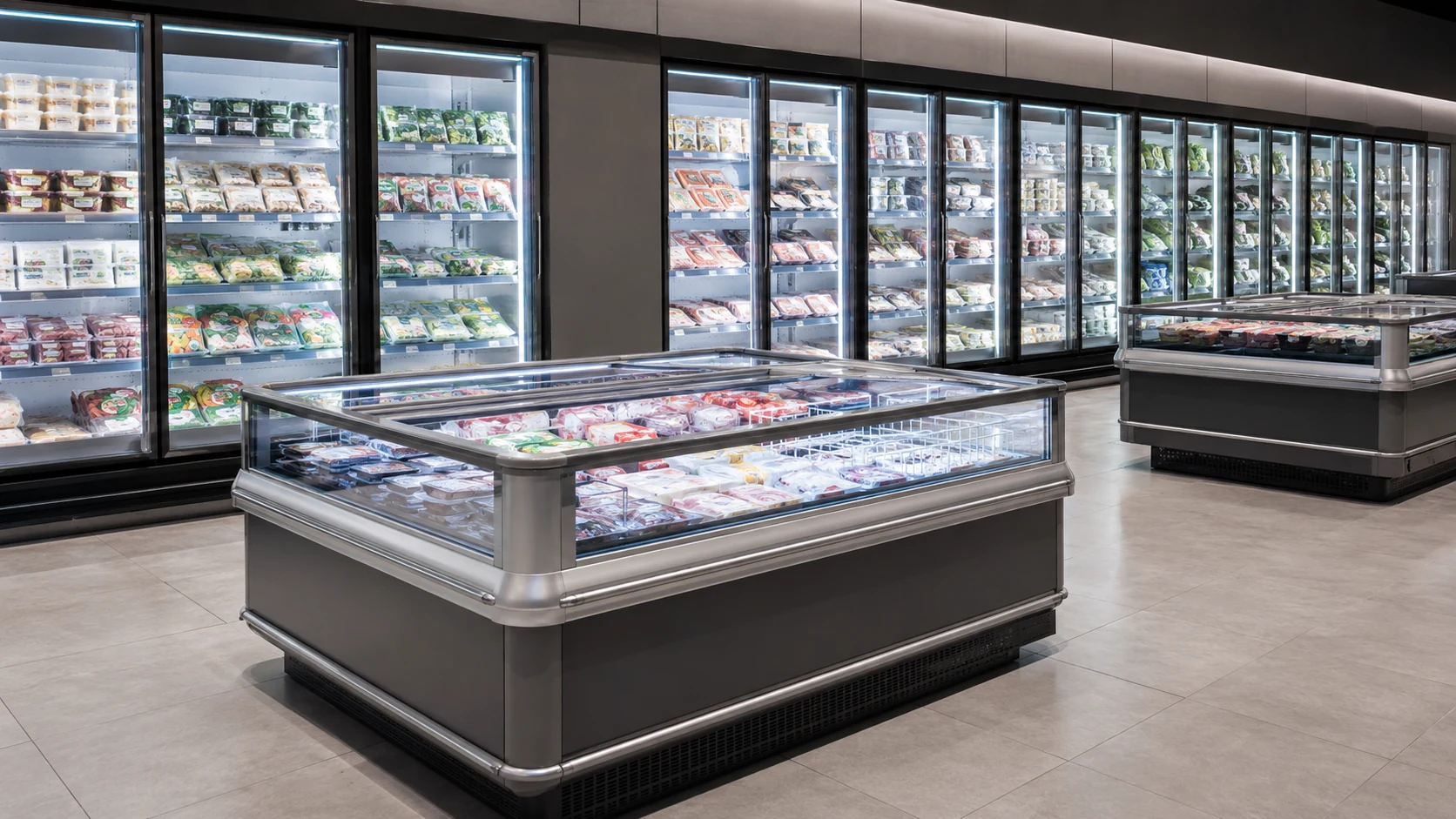
Identify whether the buyer needs cold storage, customer-facing display, preparation refrigeration, ice production or a project-scale cold room. A reference picture alone cannot determine actual performance.
Write the required product temperature, local ambient conditions and usage pattern. Cabinet capacity, cooling performance and energy ratings are valid only within stated conditions.
Specify site voltage, frequency, phase, electrical protection and connection. Do not assume 50 Hz and 60 Hz machines are interchangeable; require model-specific confirmation.
Identify the destination and product category before discussing efficiency or safety labels. Request model-specific evidence rather than accepting generic CE, UL or energy claims.
Compare refrigeration package, controls, racks, accessories, packing, transport boundaries, lead time, warranty and spares using the same quantity and Incoterm.
Keep a supplier-approved model sheet, drawing and quotation revision as order attachments. Unknown technical details should remain marked “To be confirmed,” not silently assumed.
04 / Reusable RFQ structure
Send specifications—not just “Please quote your price list.”
Copy the following fields into an email or equipment schedule. Replace every bracketed prompt with actual project information. Leave any unavailable information explicitly marked as not confirmed instead of making up the value.
For mixed projects, use one line per distinct refrigeration equipment type. Ask for a separate offered model sheet and record any optional accessories, site installation, commissioning and logistics exclusions.
Destination and installation: [country / site]
Equipment purpose: [storage / display / project]
Contents and required condition: [details]
Target operating temperature: [requirement]
Ambient conditions and usage: [details]
Cabinet / room dimensions: [W × D × H]
Daily / peak loading: [details]
Electrical supply: [V / Hz / phase]
Compliance or document needs: [market / scope]
Quantity and trade term: [qty / Incoterm / place]

Please identify the offered model and confirm its performance basis, components, drawings, nameplate, included accessories, packing, delivery, warranty and any exclusions.
05 / Relevant PRIME resources
Different buying decisions deserve different supporting guides.
Use these existing pages for equipment format, repairability, destination-market regulations and the broader import process. This RFQ checklist complements rather than duplicates their purposes.
Frequently asked questions
What buyers should confirm before placing an order.
Can suppliers quote from a photo?
Pictures identify the intended equipment format, but not guaranteed temperature, usable capacity, materials, electricity, included components or certification. Written model-level details are needed.
Is the same checklist enough for ice machines and cold rooms?
No. Ice production also requires daily demand, storage, water quality and cooling conditions. A cold room requires heat-load inputs, room drawings, product loading and site installation scope.
What should a 60 Hz buyer confirm?
Provide the destination supply including voltage, frequency and phases. Ask the supplier to confirm the actual model’s compressor, controls, nameplate, rated performance and local electrical conformity.
What does plug-in versus remote cooling change?
A plug-in unit normally includes its own refrigeration package. A remote system requires separate coordination of refrigeration units, refrigerant pipework and commissioning responsibilities. Specify the supply boundary.
What documents should accompany a commercial refrigeration quotation?
At minimum request the exact offered model, technical sheet, dimensional drawing, electrical details, refrigerant information, operating conditions, included accessories, packing, warranty and applicable market-specific compliance documents.
Does PRIME manufacture every listed machine?
PRIME positions itself as a China equipment sourcing and procurement coordination partner. Specific factory availability, technical data, certification and delivery terms must be confirmed for each project.
PRIME · China equipment sourcing coordination
Ready to compare commercial refrigeration suppliers?
Send the actual operating duty, quantities and destination. PRIME can review the inquiry scope and coordinate supplier quotations. Final specifications, availability and compliance evidence require model-specific confirmation.