Ice Machine Production & Bin Sizing: A Peak-Demand Worksheet
A daily production figure does not tell you whether the bar, breakfast service or event can get enough ice during its busiest hours. Compare production, usable storage and recovery time as three separate requirements.
Use the planning worksheet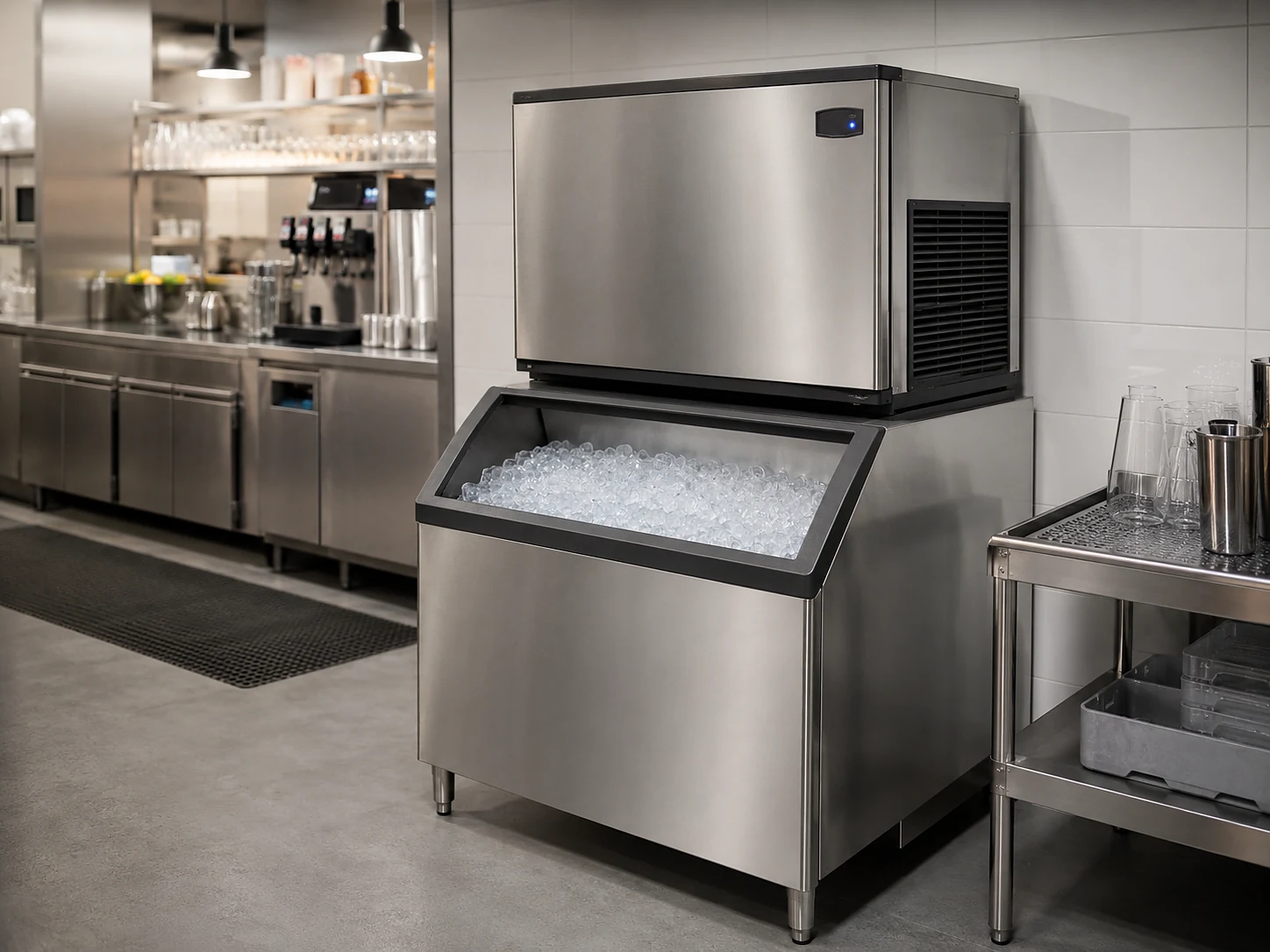
Production
How much ice can the offered machine make at your actual air and inlet-water temperatures?
Storage
How much usable ice must be available before the peak service period begins?
Recovery
Can the system rebuild its reserve before the next service peak?
Start with an operating-day profile
Record ice withdrawals by service period, not just by customer count. Include drinks, displays, kitchen use and any secondary station taking ice from the same bin. Record weekday, weekend and event patterns separately.
Scotsman’s sizing guide distinguishes hourly, daily and weekly demand and asks buyers about ice form, additional uses, equipment dimensions and the bin or dispenser arrangement. Hoshizaki’s technical guidance notes that high summer air and inlet-water temperatures can coincide with reduced output. Ask each supplier for the production data that matches your installation, rather than using its most favorable catalogue rating.
References: Scotsman machine sizing guide · Hoshizaki technical FAQs.
Build a peak-period ice balance
Use one unit throughout, such as kilograms. For a first planning check, calculate:
This is a planning balance, not a machine rating or a final bin-size recommendation. Actual production arrives in cycles; a full-bin control may stop production, and some stored ice may not be usable at the moment it is needed. Check shorter intervals when demand is concentrated.
Worked example: an illustrative three-hour service
Demand
75 kgTotal withdrawals over three hours.
Production
30 kgAssumed usable output of 10 kg/h during that service, to be verified for the selected machine.
Opening stock
55 kg75 + 10 kg planned reserve − 30 = 55 kg, excluding additional losses.
If withdrawals are 40, 20 and 15 kg in successive hours, the simplified end-of-hour stock is 25, 15 and 10 kg. If the first 40 kg is needed at opening, however, it cannot be supplied from ice that will only be made later. Discuss the timing with the supplier, then select the bin’s usable capacity and operating reserve.
These are hypothetical numbers demonstrating the method, not PRIME product specifications. Add measured or supplier-agreed allowances for losses and service interruptions; do not apply an arbitrary percentage to every project.
Check the next peak, not just the first one
After service, calculate the stock deficit and available refill period. With no withdrawals, replacing 45 kg at a verified 10 kg/h would take about 4.5 hours in a simplified balance. Continued service, cleaning stops or reduced output extend that time.
A larger bin helps store ice made earlier, but cannot cure a persistent daily production shortage. A higher-output head does not solve a bin that is too small or inaccessible during peak service.
Ask suppliers to compare three options
- Keep the machine and increase compatible usable storage.
- Increase production with a matched head-and-bin system.
- Use separate stations when different ice forms or service locations require them.
Compare complete installed scope, service access and utilities, not machine price alone.
Send a quotation-ready worksheet
Application and ice form:
Daily withdrawals / busiest service period:
Peak duration and withdrawal timing:
Required stock before opening:
Required reserve after service:
Available refill hours between peaks:
Air temperature / inlet-water temperature:
Water quality, supply and drain arrangement:
Electrical supply (V / Hz / phase):
Maximum installation space and access:
Existing head, bin and adapter model:
Destination and applicable documentation:
Quantity and required delivery scope:
Ask the supplier to return the exact model, production basis, usable bin capacity, compatibility confirmation and installation drawing. Identify who supplies the filter, adapter, drain components and any remote condenser package.
Compare ice-machine formats · General refrigeration RFQ checklistBuyer questions
Can I divide the 24-hour production rating by 24?
Only as a rough first estimate under the same stated rating conditions. Ask the supplier to confirm real cycle output, operating temperature effects and available production during the service window.
Is bin capacity the same as production capacity?
No. One is stored ice available at a point in time; the other is ice made over a period. Confirm the usable storage definition, not merely external bin dimensions.
Does a bigger machine always solve shortages?
No. First separate inadequate daily output, insufficient opening stock, refill-time constraints and installation problems. Each calls for a different solution.