
Resources / Material Selection
Commercial Kitchen Materials · Buyer Guide
304 vs 201 Stainless Steel for Commercial Kitchen Equipment
A buying guide for stainless steel work tables, sinks, cabinets, shelves and made-to-order kitchen equipment. Compare the grade, exposure, component coverage, fabrication and supplier evidence before approving the quotation.
Short answer
Choose the material by working conditions—not by appearance.
304 is widely specified for commercial kitchen applications, including frequently cleaned wet areas. 201 is a real austenitic stainless steel used in catering equipment and may be appropriate for defined uses. The correct choice depends on the exact grade, intended exposure, construction, customer specification and destination-market requirements.
01 · Material comparison
304 vs 201 stainless steel: what actually changes?
Both alloys are austenitic. Their chemical composition, forming behavior and project suitability differ. The exact supplied grade must match a defined standard; general market labels are not enough.
| Review item | 304 stainless steel | 201 stainless steel | Buyer action |
|---|---|---|---|
| Alloy family | Chromium–nickel austenitic steel | Chromium–manganese–nickel austenitic steel | Name the exact grade and material standard. |
| Typical chemistry* | Cr 18.0–20.0%; Ni 8.0–10.5% | Cr 16.0–18.0%; Ni 3.5–5.5%; Mn 5.5–7.5% | Confirm the material certificate and batch traceability where required. |
| Corrosion suitability | Often specified for regular wet-cleaning kitchen applications | May be appropriate in specified environments; suitability varies with grade and exposure | Identify salt, moisture, sanitizers, cleaning frequency and any chloride exposure. |
| Forming and construction | Common for welded and fabricated kitchen equipment | Different strength and work-hardening behavior can affect forming | Compare weld finish, edge treatment, reinforcement and workmanship. |
| Procurement positioning | Often selected for buyer requirements and durability expectations | Sometimes selected where its lower nickel content offers a cost advantage | Compare full fabricated specification, not just material price. |
| Food-contact questions | Grade alone is not proof of compliance | Grade alone does not establish approval or prohibition | Confirm applicable destination-market and product-specific requirements. |
*Indicative composition ranges are from standard UNS S30400 and S20100 grades, not a substitute for a supplier’s material certificate. Technical reference: worldstainless grade composition comparison.
02 · Application review
Evaluate the equipment’s real operating environment
These examples are buying considerations, not universal approvals or prohibitions for either grade. Cleaning conditions and fabrication quality are essential.
Washing equipment
Check water exposure, detergent or sanitizer chemistry, chlorides, standing moisture and welded seams. Identify the grade of sink bowls, draining boards and splashbacks.
Work tables
Confirm tabletop contact requirements, washdown frequency, thickness and reinforcement. State material grades of tops, backsplashes, undershelves and legs separately.
Shelves and cabinets
Review humidity, coastal conditions, handling and cleaning. A mixed-material construction needs prior acceptance and an explicit component list.
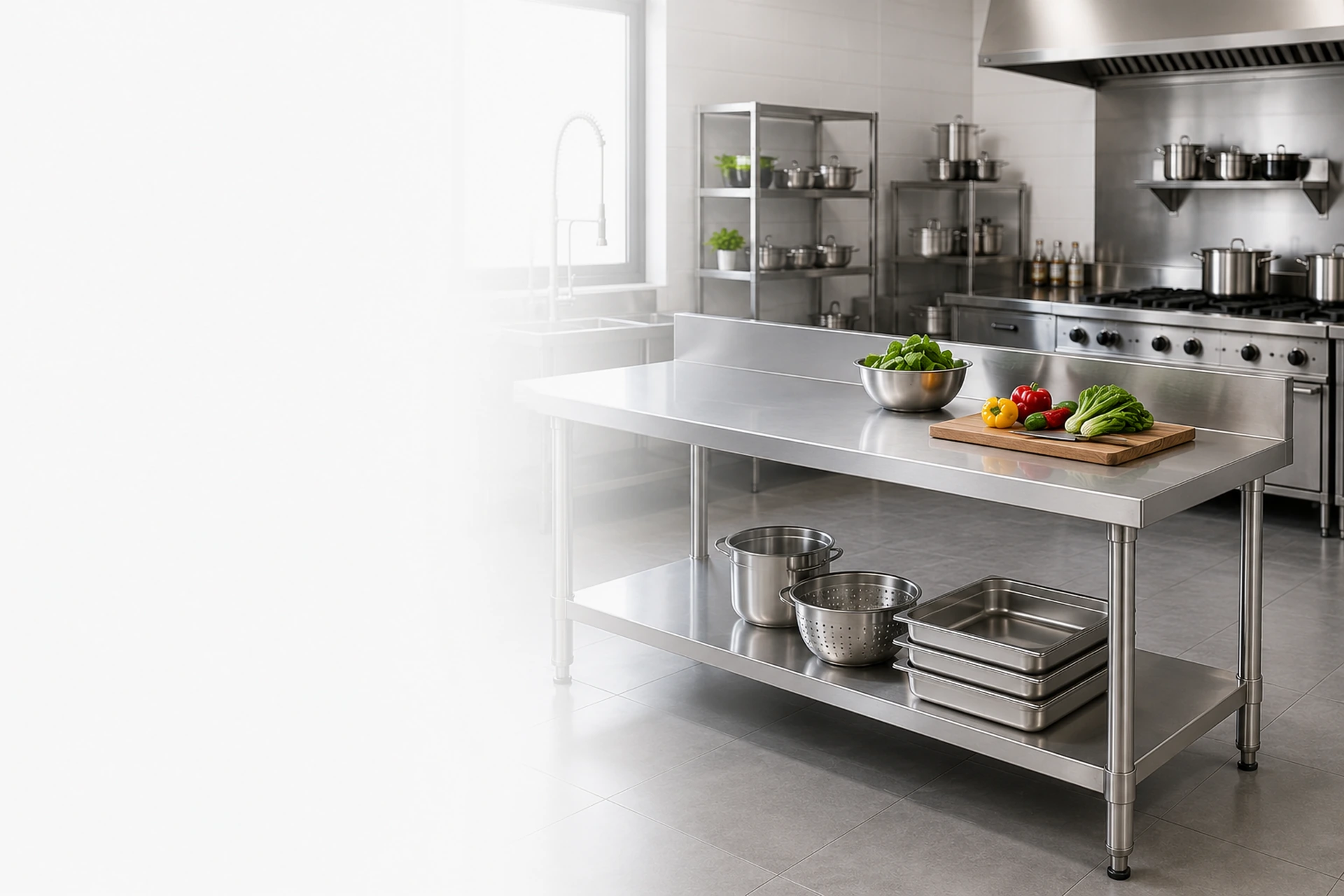
Steel grade alone cannot describe the finished equipment.
Two visually similar products may differ in thickness, weld treatment, bracing, surface finish and load performance. Compare quotations at the same specification level.
Related product pages: stainless steel work tables and commercial stainless steel sinks.
03 · Procurement details
Ask for a component-by-component material schedule
Suppliers should clarify whether the complete unit is made from the quoted grade or whether selected parts use a different grade. Review material identity together with structure and workmanship.
Confirm thickness and finish alongside the grade.
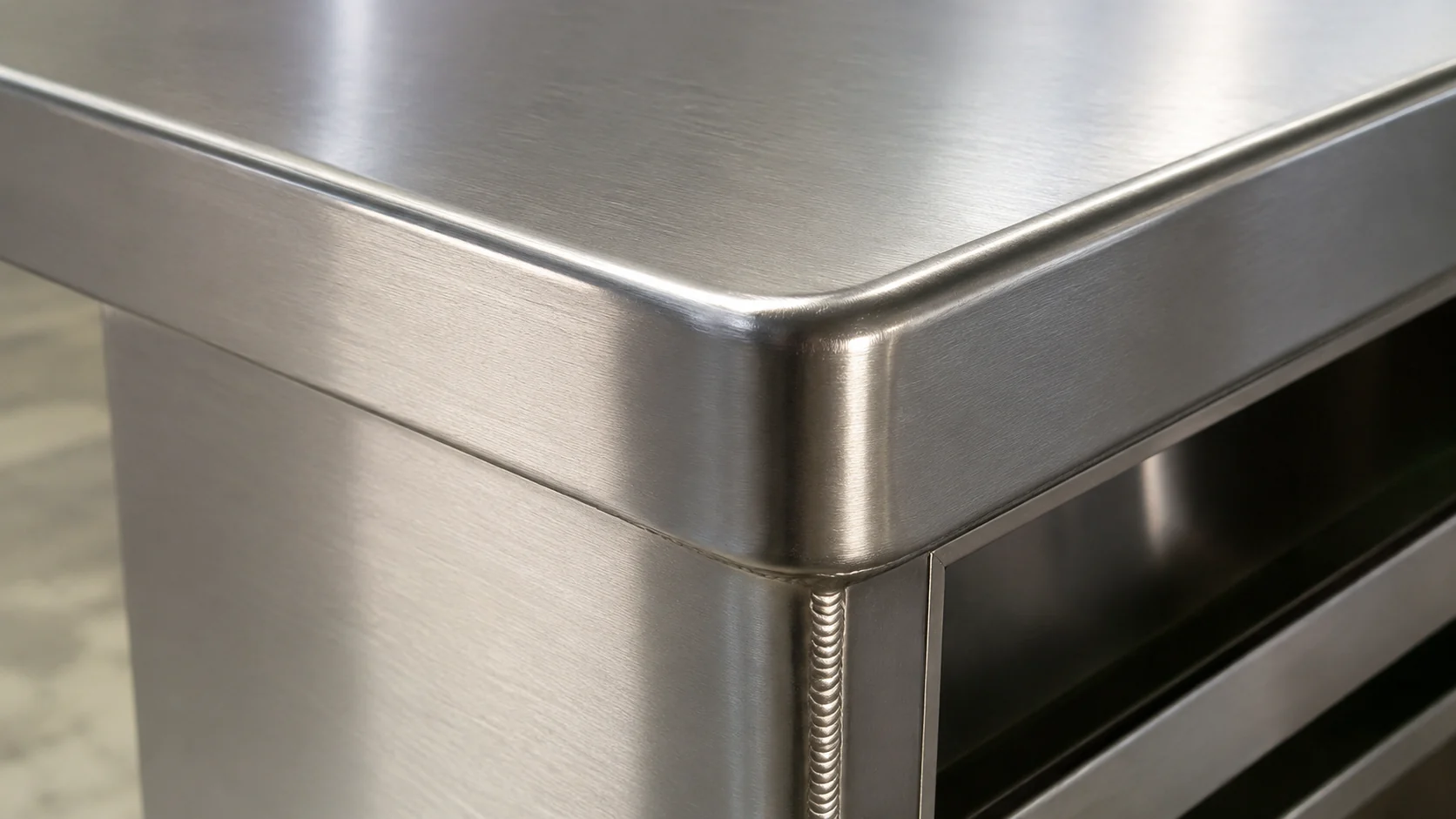
A supplier quote should identify sheet thickness, load and reinforcement expectations, surface grain, edge finish, weld cleaning, and packing protection. A material designation does not establish product rigidity or service life on its own.
For special dimensions and drawing-based projects, review custom stainless steel kitchen equipment.
For storage and movement applications, also review the construction requirements of commercial wall shelves, storage racks and kitchen trolleys.
04 · Supplier checks
Four verification steps before order release
Match the level of material verification to the project value, customer requirement and substitution risk.
Define service conditions
List washing methods, moisture, temperatures, cleaning chemicals and site environment.
Confirm each component
State material grades for tops, bowls, shelves, support frames, legs, doors and fittings.
Validate supplier evidence
Agree on mill certificates, heat/batch links and suitable PMI or inspection for higher-risk orders.
Approve before shipment
Check drawings, thickness, dimensions, welds, finish, photos, packing and any required reports.
05 · Ready for enquiry
What to include in your supplier RFQ
Use the following checklist to prevent ambiguous “304 stainless steel” or “201 stainless steel” quotations for products with multiple fabricated parts.
Frequently asked questions
Material selection questions buyers should resolve
Is 201 stainless steel suitable for commercial kitchens?
It can be suitable in certain defined applications. Evaluate the exact grade, use conditions, fabrication, cleaning regime, buyer expectations and destination-market requirements rather than applying a blanket rule.
Is 304 automatically food safe?
No. The finished equipment, contact surfaces, intended use and applicable market-specific requirements must be evaluated; the grade number alone is not a certificate of compliance.
May a supplier use 304 for the top and 201 for the frame?
Only where the buyer accepts that construction and the application is suitable. Ask for a written component-by-component grade schedule in the quotation and approved order.
Can a magnet distinguish 304 from 201?
No reliable stand-alone magnetic test can confirm these stainless steel grades. Suitable material documentation and testing are more appropriate.
What matters besides the stainless grade?
Sheet thickness, weld quality, reinforcement, rigidity, surface finish, edge details, workmanship, packaging and specified inspection evidence.
Further industry sources: British Stainless Steel Association, grade 201 and worldstainless, grades and product forms. Project-specific food-contact and regulatory requirements must be confirmed separately.
Request a specification-based quotation
Share the equipment list, dimensions, quantities, preferred grades, working environment and destination. PRIME can coordinate supplier clarification and quotation review.